Showing posts with label Ponder food. Show all posts

Saturday, February 27, 2016

From Columbus to Celebrity chefs: How Food Helped Shape History

"Parrots and Fruit with Other Birds and a Squirrel," Tobias Stranover, c. 1710

Food. Food is essential to sustain life, has had a massive impact on the planet's environment, caused conflict between peoples and nations throughout history, and been a source of inspiration for artists and a source of entertainment for modern television audiences tuning into the latest episode of "Cutthroat Kitchen." Despite the undeniable and overwhelming importance of food, the study of the history of food remains an emerging field. It was with this in mind that Paul Freedman, a professor at Yale University, began teaching a course entitled "The History of Food" in 2009.

Freedman believes that studying the history of food can tell modern historians a lot about societies of the past, including what their diets looked like and how they produced food to feed their populations. Additionally, he points out that a number of historical events have been caused by changing tastes, exemplified by demand for sugar. The growing European taste for sugar, which was used in tea, coffee, and sweets such as chocolate, motivated European nations to establish plantations in colonies in Brazil and the Caribbean, which were worked by African slaves sent there for that purpose. Thus, Freedman argues, sugar was a driving factor behind one of the most "cataclysmic movements of people in history." In a similar fashion, expeditions like that of Columbus in 1492 were also motivated by food, this time the desire for spices from India. It is possible to conjecture that European colonization of North America may have been delayed, had Columbus not been searching for the mouthwatering flavor of Indian spices.

Outside of being a driving factor behind the colonization of the Americas, food has been featured prominently in art throughout the ages, particularly in Dutch still life paintings of the 17th and 18th centuries. Within a still life, food could have allegorical meaning, referring to stories from the Bible or acting as a memento mori, or could function as a symbol of wealth. Depictions of exotic, expensive fruit and nuts were status symbols that reflected the wealth of the owner of the painting. This practice could be compared to how a photo of a bottle of costly cold-pressed juice on Instagram is intended to reflect the wealth of its poster. Food is also an extremely popular source of entertainment for modern television audiences; the existence of the scores of food-related shows that are seemingly always available are evidence of the powerful ability of food to entertain.

Perhaps generations of the future will look back at television shows and Instagram posts to determine how food impacted the lives of those of the 21st century, much like how Freedman have used the historical record to track the effects of food on global history. Whatever the outcome, it is clear that the study of the history of food is one that holds great importance for both the past and the future.

Pierre Javelle and Akiko Ida: The Minimiam Universe


Akiko Ida and Pierre Javelle combine photography, magical landscapes, culinary backdrops, and portraiture to create settings inhabited by diminutive characters, referred to as minimiam. Each diptych reveals to the viewer a whimsical land that plays with our minds, as well as the subject. Akiko, Japanese, has always been attracted to the world of gastronomy. As a child, she invented tiny characters that populated her journal. She is a renowned food photographer. Akiko has participated in more than 30 cookbooks and her work is published in international magazines. Pierre, French, grew up on comics. He is published in major gourmet magazines and his still-like photographs appear in corporate commercials.

The MINIMIAM project morphs multiple genres of photography, including microphotography, culinary art, portraiture and landscape. The action, ranging from sporting scenes to warfare, takes place in carefully staged, fantastic, food settings. In each work, the first image introduces toy-like actors in an ambiguous setting. The second panel reveals the scene’s totality, to an unexpected, often amusing end. Though generally light-hearted and playful, the artists’ work intelligently probes fundamental questions of human perception, and how meaning is constructed and manipulated through images. 

Sophisticated photographic devices form the core of the artists' expression, which both entertain and unsettle the viewer. Using extremely short depths of field with very small apertures, the miniature characters are sharply in focus, while the surrounding landscapes are blurred. At the same time, their diminutive size contrasts with the gigantic surrounding space, allowing the viewer's eye to freely wander around the entire scene. Stage set lighting silhouettes the actors adding drama to the story, and intensifying the textures and colors of the edibles. Our appetite is piqued.

(http://madelynjordonfineart.com/exhibition/focus/pierre_javelle_and_akiko_ida_the_minimiam_universe)

Tuesday, November 24, 2015

Artists Ponder Food: Song Dong

Beijing-based artist Song Dong (b. 1966) explores notions of impermanence and the transience of human endeavor. 
Waste Not


"Finally, in 2005, Mr. Song proposed that they turn the accumulated junk into an art project. In this way, he argued, nothing would be discarded and lost; everything would be meaningfully recycled and preserved. His mother agreed to this and they emptied the premises. Then, in an exhibition space in Beijing, they sorted its contents into the kinds of meticulous piles and groupings seen at MoMA: stacks of neatly folded shirts, clusters of bottles and cans, groupings of stuffed animals and so forth, arranged in and around a dismantled section of the original wood house. As a finishing touch, Mr. Song created a neon sign reading, 'Dad, don't worry, Mum and we are fine,' and hung it over the installation." Credit: Todd Heisler/The New York Times

Artists Ponder Food: Juergen Tellers

For the cookbook Eating at Hotel Il Pellicano, Teller photographed the creations dreamt up in the retreat’s kitchen by chef Antonio Guida, who won the restaurant two Michelin stars during his time there.
Food No.15, Hotel Il Pellicano 2010


Food No.113, Hotel Il Pellicano 2010


Captured in Teller’s recognizably edgy and impish aesthetic, Guida’s recipes emerge as whimsical fantasies bordering precariously on the hedonistic, meticulously crafted artworks to be consumed in the passion of a moment, to be vanished but unforgotten.
Food No.102, Hotel Il Pellicano 2010


Food No.18, Hotel Il Pellicano 2010

Artists Ponder Food: Jennifer Rubell

Jennifer Rubell creates participatory artwork that is a hybrid of performance art, installation, sculpture, and happenings. The pieces are often staggering in scale and sensually arresting, employing a wide range of media, both durable and ephemeral.


Old Fashioned (2010)


The title, Old-Fashioned, both identifies the variety of donut hanging on the wall (the most basic and elemental in Dunkin’ Donuts’ lineup), and raises the question of what "old-fashioned" might mean in a contemporary-art context. As viewers enter the courtyard, they are faced with an 8-foot by 60-foot freestanding wall. The front of the wall is pristine, with 1,521 donuts hung in a grid formation at perfect 6-inch intervals.

Friday, January 31, 2014

Feature Shoot and Junk Food

Fruit Loops Landscape was chosen to be a part of the Feature Shoot Junk Food exhibition! Curated by Emily Shormick, photo editor of The Cut at New York Magazine, we are thrilled to be part of this online exhibition.

Fruit Loops Landscape from Processed Views

Searching for food landscapes on Feature Shoot's website yields wonderful work by other photographers who explore this topic. Alexander Crispin's delicacy and playful approach embellishes his elaborate and humoristic work.

Alexander Crispin, Lantmännen 


Continue searching Feature Shoot "food and people," you will find Chris Maggios, also known as  "Male Chef". Maggio's series are stark and repulsive, but utterly refreshing.

Image from "Male Chef"

Saturday, December 7, 2013

Holiday Party Food

Our culture's love of technology is equaled by it's love of celebration.  Since the l970's these all-American predilections have come together in the food processing industry.  As we approach the holiday tables laden with high protein party food, let us be thankful, skeptical and consider the unintended consequences of love and health in the most recent World Cancer Research Fund review on processed meats and cancer.


Saturday, November 9, 2013

A Cornucopia of Foodish Photography

Alison Zavos, of  the always fascinating Featureshoot blog has chosen images from ‘Fruitland’ a Group Show of Strange Fruit Photos, Opening at Photoville, Brooklyn.

Zavos notes, "Perhaps as a response or antidote to the labored and moody Dutch still life-inspired food photography that has been proliferating in galleries over the past decade, young photographers are now challenging themselves to take a regular piece of fruit and make it special, adding an array of strange, unique twists."

Athos Burez  Still Life III  16 x 20 in.  Archival Pigment Print

Athos Burez Sarah Ferri 16 x 20 in .Archival Pigment Print

Daniel Stier  The Nature Paradox  16 x 20 in.  Archival Pigment Print

Daniel Stier  The Nature Paradox  16 x 20 in.  Archival Pigment Print

Aron Filkey & Mate Moro  HappyFew No. 9  15 x 20 in.  Archival Pigment Print


Food Porn

This work reminds us of the Chicago Imagists, an interesting mashup.

Food Porn 

Food Porn

Food Porn


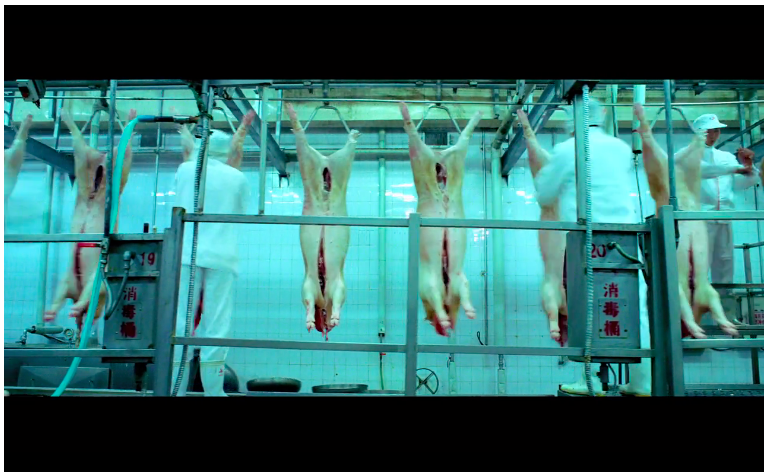
Consider Patrick Cudahy and Pig Business

May 29,1913
The Patrick Cudahy meatpacking plant, which traces its history in the Milwaukee area to the 19th century, may soon be owned by the Chinese.
The plant is part of a proposed $4.72 billion deal that would be the biggest purchase ever of a U.S. company by interests in China. The deal calls for Patrick Cudahy's parent company, Smithfield Foods, to be purchased by Shuanghui International Holdings Ltd., the majority shareholder in China's largest meat processor.
The proposal led to some perplexed reactions about the prospect of Sweet Applewood Smoked Bacon soon being owned by a company in one of the last bastions of Communism on the globe, a country that brought the world cheap labor and outsourced jobs.
"I think there are people who will say this is 100% horrible. I think there are some who will say it's a great thing — it's an opportunity for U.S. agriculture to get U.S. products into the hands of Chinese consumers," said Jeff Sindelar, an associate professor who researches the global meat industry at the University of Wisconsin-Madison. "And then I think there is a larger segment of people right now who aren't really sure."

The impact of industrial food production on our planet is discused in the four minute interview film Pig Business.  A more poetical view of the dilemma of the place in the wheel of life may be seen in this short exerpt from the 2011 film, Samsara.


Thursday, February 16, 2012

Industry Research - Transition to Savory Grains

As we make the transition from shooting sweet cereal to the savory grains, so does Kellogg's, which just bought Pringles, the second largest savory snack product in the world. This move will boost Kellogg's snack division to 40% of total sales. According to the Wall Street Journal, Kellogg Chief Executive John Bryant said the move isn't an indication that the Battle Creek, Mich., company is worried about the future of cereal. "We love the cereal business. It's a long-term growth business," he said in an interview. "This is an add for us—it's not running away from anything."
[PRINGLES_p1]
Here's our Ingredient List: