Showing posts with label Industrial Agriculture. Show all posts

Saturday, November 9, 2013

Consider Patrick Cudahy and Pig Business

May 29,1913
The Patrick Cudahy meatpacking plant, which traces its history in the Milwaukee area to the 19th century, may soon be owned by the Chinese.
The plant is part of a proposed $4.72 billion deal that would be the biggest purchase ever of a U.S. company by interests in China. The deal calls for Patrick Cudahy's parent company, Smithfield Foods, to be purchased by Shuanghui International Holdings Ltd., the majority shareholder in China's largest meat processor.
The proposal led to some perplexed reactions about the prospect of Sweet Applewood Smoked Bacon soon being owned by a company in one of the last bastions of Communism on the globe, a country that brought the world cheap labor and outsourced jobs.
"I think there are people who will say this is 100% horrible. I think there are some who will say it's a great thing — it's an opportunity for U.S. agriculture to get U.S. products into the hands of Chinese consumers," said Jeff Sindelar, an associate professor who researches the global meat industry at the University of Wisconsin-Madison. "And then I think there is a larger segment of people right now who aren't really sure."

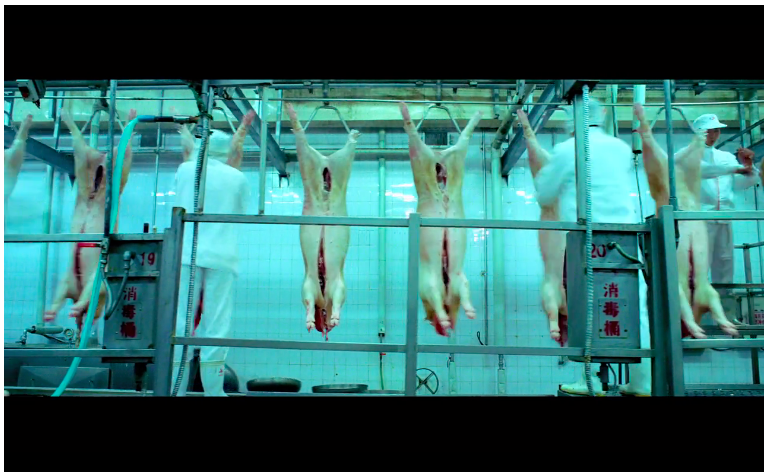
The impact of industrial food production on our planet is discused in the four minute interview film Pig Business.  A more poetical view of the dilemma of the place in the wheel of life may be seen in this short exerpt from the 2011 film, Samsara.


Corn has a Big Impact on the Land

Research for Cornscape  revealed the imbalance between nutritional advantages and depletion of the fertility of the land. How best to present this dilemma in our image?

Environmental Impact calculates depletion factors of the midwestern agriculturally corn-centric states. Consider the real cost of a box of flakes…and so many more foods.
Commercially grown corn. The data here comes from the University of Nebraska and reflects the averages for the Midwest United States. It should not come as a surprise that the most important resources for growing corn is land, water, fuel and fertilizer. The electricity is used mostly for the irrigation systems, but also in planting, harvesting, etc.Some facts about corn:
  • The yield is about 155 bushels of corn (56 pounds each) per acre,
  • The irrigation, in average, covers the field with about 2 inches of water per growing season
  • In addition to fertilizers, a significant amounts of lime are spread on the corn fields (about 212 kg/hectare)
  • About 45% of corn kernel is carbon, obtained from the atmospheric CO2. We include this as a negative number for the release of carbon dioxide pollution (that is, as carbon sequestration).
PI - Pollution Index. Indication of the amount and severity of the pollution generated during the life cycle of an item. The higher number, the more pollution.
DI - Depletion Index. Indication of the amount of resources used during production and disposal of an item. The higher number, the more resources are used (and the less sustainable the product is).
EI - Entropy Index. - Indication of the amount of energy wasted during the life cycle of an item. The higher number, the more energy is wasted.
CEII - Composite Environmental Impact Index. Indication of the item's impact on the environment, taking into account the resources used and the pollution generated during production, use, and disposal of the item. The higher number, the higher impact.


study for Cornscape in Processed Views

study for Cornscape in Processed Views

study for Cornscape in Processed Views